The conclusion here is clear: the industry will want different things from you as it evolves, and it will tell you that each of those shifts is because of some complex moral change, but it’s pretty much always about business realities changing. If you take any current morality tale as true, then you’re setting yourself up to be severely out of position when the industry shifts again in a few years, because “good leadership” is just a fad.
The key is that you engage with your daily activities mindfully in a way that keeps your weekly update in mind. What I mean by this is that you are always on the lookout for:
Direct experiences that you have had that would be valuable to share with the team. This could be anything from conversations with customers to shareable summaries of closed-door meetings such as executive reviews.
Events that can be celebrated, such as a big project shipping, a long-standing bug being resolved, or performance improvements that have been rolled out.
Things that could be improved, such as an incident that happened, an inefficient process that is causing friction, or data that highlights a problem that needs to be fixed (e.g. a drop in performance or an unexpected increase in infrastructure costs).
Events that are happening in the near future that you want to remind people about.
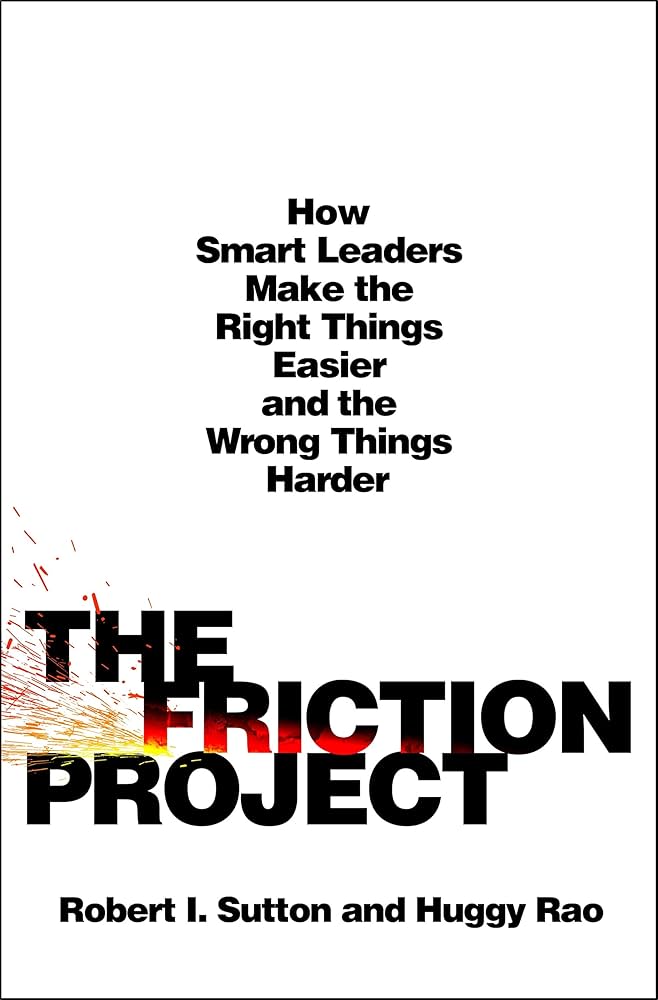
The Friction project collects strategies for removing and adding friction so organisations function better.
Here are some choice cuts.
Why friction is good and bad
We soon learned that the goal of becoming a “frictionless organization” is misguided. Yes, the people who run most organizations create too much debilitating friction. But many also ignore the opposite side of the coin, making the wrong things too easy for employees and customers.
…
The harder we humans work at something, and the more we suffer, the more we come to value it (independent of its objective value) because of our need to justify all that work to ourselves and others.
A trustee of other’s time
In August 1940, as his country prepared for waves of attacks by German planes, Winston Churchill set out to address a different enemy. In his 234-word “Brevity” memo, 1 he implored his colleagues to “see to it that their Reports are shorter.” The British prime minister urged them to write “short, crisp paragraphs,” to move complex arguments or statistics to appendices, and to stop using “officialese jargon” and “woolly phrases.” A few months later, Churchill asked bureaucrats to hear his “cry of pain” and remember that “the number and length of messages sent by a diplomat are no measure of his efficiency.”
…
Rohm and Haas teaches its leaders that when they face a decision with broad and enduring consequences, taking speedy, narrow, and impulsive action is a recipe for disaster. Instead, Rohm and Haas preaches the Five Voices method. Before making a big decision, leaders slow down, do careful research, and talk to people until they understand five key stakeholders: the customer, the employee, the owner, the community, and the process.
…
“There comes a point where we need to stop just pulling people out of the river. We need to go upstream and find out why they’re falling in.”
Overcoming power poisoning
If you are more powerful than your colleagues or customers, you are at risk of being clueless about their friction troubles, and of how you add to their misery. Beware of such power poisoning.
…
“If you are the HIPPO, don’t be a hippo, be an elephant.”
i.e. have big ears rather than a big mouth.
…
The lesson, and perhaps the irony, of Tsedal and Sebastian’s study is that executives who deferred to subordinates moved up the pecking order faster than those who refused to bend to their underlings’ will and wisdom: Leaders were granted more power because they gave it away.
…
After Lindy’s team analyzed more than a hundred hours of observations and sixty interviews from ten start-ups, they found the best CEOs shifted between accentuating and flattening the hierarchy—and the worst ones treated the hierarchy as static.
When one CEO was asked if her team was flat or hierarchical, she explained, “You have to have both. If you don’t have that flat piece where you’re taking everyone’s input, you’re dropping expertise on the table, and if you don’t have a hierarchical piece, then you’re just heading in all different directions.” The best leaders “activated” their authority to squelch destructive conflict, when discussion and debate became repetitive, and time pressure necessitated immediate decisions. These flexible leaders “flattened” the hierarchy when creativity, problem-solving, and buy-in were top priorities.
Using subtraction to remove friction
People tend to add stuff to their work environments.
One of the more effective ways of removing destructive organisational friction is to instead subtract things.
Techniques for repairing coordination snafus
Onboard People to the Organization, Not Just the Job – Friction fixers who are intent on building a culture of coordination go beyond training newcomers to perform their narrow job responsibilities. They teach newbies how their work meshes with that of others, how the organization functions, and how to use the system to help them do their work. This saves a lot of trouble down the road.
…
Build Roles and Teams Dedicated to Integration – The idea here is to create specialists in your organization who are charged with integrating the once-disconnected roles, silos, and action. The Cancer Center created a centralized CarePoint program to reduce the cancer tax for patients and their families. CarePoint administrators use their knowledge and relationships to smooth patient journeys, and when problems arise, patients and families have a place to turn for help.
…
Fix Handoffs – Bungled information exchanges between people in different roles, silos, shifts, and time zones are among the most potent causes of coordination snafus.
Applying good friction
Anthropologists and sociologists document how, when something ends, people benefit from pausing to reflect on the past, what they’ve lost, what comes next, and what matters most and least to them—and to support one another. Be it the end of a meeting, a day, a game, a career, a life, a team, a project, or an organization.
…
Patty McCord, who was Netflix’s chief talent officer for the company’s first fourteen years, told us, “The most important role I played at Netflix was, at the end of every executive meeting, to say, ‘Have we made any decisions in the room today, and if we have, how are we going to communicate them?’”
Leading friction fixing
The third leadership principle is organizational design is the highest form of friction fixing. Most of the time, leaders don’t have the luxury of designing a workplace from scratch. So most must find ways to manage in existing and imperfect systems.
The “socio” and “technical” of sociotechnical systems are not neatly separable, they are interwoven and interdependent. There is actually precious little that is purely technical work or purely people work; there is a metric shitload of glue work that draws upon both skill sets.
…
If you aren’t making building the organization someone’s number one job, it won’t be anyone’s number one job, which means it probably won’t get done very well. And whose responsibility will that be, Mr. CEO?
regardless of how much autonomy and self-directed time you accumulate, optimal allocation of your capacity is not a box packing problem where you must allocate every single minute of your day. This is an anti-pattern.
…
If we’ve been lucky enough to work with leaders that manage their capacity well, then we may have been surprised that when we reach out with something urgent, they are able to respond quickly and effectively: perhaps they’ve offered to jump on a call straight away. This isn’t luck or anything to do with you. It’s just good capacity management on their part. Make sure that you’re always available for your team when they need you.
Hiring for additivity requires intentionality. It seeks to answer the question “how does this person change us for the better?” It avoids both stagnation and a lift-and-shift cultural change.
And to make a long rambling story even longer and more rambling, being a manager or director or VP is kinda like this all the time. You just navigate fucked up policy after policy, deciding which pushback will work or which you have the energy for
And you will reach a limit because it’s fucking exhausting to unwind corporate cognitive dissonance all day every day, and so a bunch of unfair, ridiculous things just persist because you don’t have the mental wherewithal to keep fighting for everything.
(this is not even to account for doing the exact same thing for product and technical stuff on your team). Knowing your limit of this is a good indicator if you would succeed and enjoy management at any given scope of team/size of company
At HashiCorp, we’ve grown from a few hundred to over a thousand people, so the goal is to build scalable systems that enable employees to do their best work and contribute to the outcomes of the company. For us, that’s shaped up into three specific systems: strategic planning, knowledge management, and communications.”
They also run a simluation to give their leaders a chance to practice.
“Using a firm called BTS, we run a business simulation where leaders get to ‘run’ the business for three years. Taking a simplified view of the company, we essentially build a game board based on our five-year financial model and this year’s three executive focus areas,” says Fishner.
In my very first programming role my manager said to me “You can make any mistake you like once. You’ll have my full support the first time you screw anything up. If you’re not making mistakes, you’re not learning, and if you’re repeating mistakes you aren’t either”.
the research is clear: Telling people what we think of their performance doesn’t help them thrive and excel, and telling people how we think they should improve actually hinders learning.
…
The only realm in which humans are an unimpeachable source of truth is that of their own feelings and experiences.
Having all the answers is not the goal. Motivating the team to find the answers is the goal.
…
To evaluate the strength of a manager, look at the strength of their team.
…
The first time any of the above happens on your watch, it’s always new and hard, no matter how many books you’ve read on the topic. But the fifth or tenth time or 20th time it happens, you’re no longer freaked out. You realize that you’ll be fine.