Knowledge Management

Content tagged "Knowledge Management".

An LLM-Augmented Work Wiki

I like to maintain my own personal set of Markdown notes for work. The act of typing ideas and information helps me process them mentally. I tend to organise my notes as a series of daily notes with links to longer-lived reference notes for concepts or projects.

I switched from NotePlan to Obsidian as a veneer over the Markdown files a while back. I didn’t have a need for NotePlan’s task management infrastructure. Obsidian is free and has loads of plugins if you want to cut loose on extending it.

I recently started a new job, which meant creating a brand-new vault, and I felt like giving the LLM Wiki approach a crack. Ultimately, having a robot do all the wiki bookkeeping for me feels like a worthwhile experiment.

The overall workflow is simple: I write in my daily note throughout the day, and I ask an LLM to process it at the end of the day. The LLM fetches relevant meeting transcripts and whatever else it can find by following links in my daily note. It then links everything together in long-lived notes covering projects, domain concepts, people I work with, and anything else it decides to maintain.

I also maintain a file called big-picture.md, which outlines the main open loops on my mind from week to week. The LLM doesn’t edit the main part of this file, though it can add reference information to a dedicated section at the bottom.

The vault is a Git repository, so both the LLM and I can use its version history to see how things have evolved over time.

I can search the long-lived notes in Obsidian to get an up-to-date view of each project, person, or concept, along with related information from linked notes.

As a bonus, during my end-of-week review, I ask the LLM to summarise my week, including which tasks or open loops I’ve moved forward or closed, and which new ones I’ve created. This helps me set my goals for the following week. I put these reflections and goals in a weekly note.

That’s pretty much it. I’ve found the reduction in bookkeeping valuable so far. I’ll see how well it scales over time.
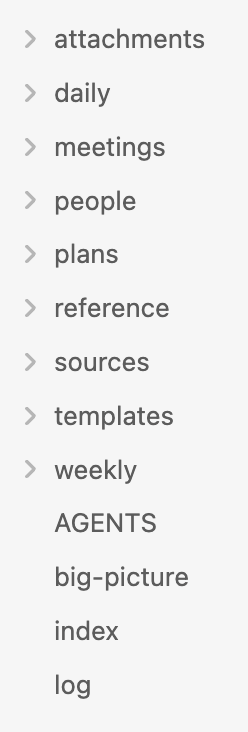
Folder and file structure of my Obsidian work vault

The layout of my work wiki

As for plugins, I try to use as few as possible. These are the ones I use in this vault.

  • At People for easily creating references to people notes.
  • Seek for better vault search than Obsidian provides out of the box.
  • Calendar for visually navigating daily and weekly notes.
  • Dataview for rolling up indexes of notes. The LLM added this and uses it; I only consume the results.
  • Mister Sheen for sanitising text pasted in from Slack and Google Docs. I got the LLM to write this private plugin to apply my preferred formatting.

Long Live the Work Journal

A window onto green grass

Keep a journal for work, champions.

It’s pretty easy to get started—just create a text file.

Throw in a new heading each day and write down whatever you did—a single line for each task is usually enough. I put the newer dates at the top so it’s less scrolling to get to the most recent content. Over time you end up with your own little private reverse-chronological blog-in-a-file.

Each day, dump in commands you’ve run; links to documents you’ve created, reviewed, or read; tasks you want to get done; or goals you want to achieve.

You’re building a little outboard brain where your work history is just a short grep away.

When that Friday afternoon ennui kicks in, and I’m trying to work out what I’ve contributed, I go back over my work journal for the week.

I’m the rigorous1 type, so each Friday, I summarise my achievements and impediments of the week in a separate note.

When it’s performance review time, I run over these weekly notes and pull together the story for the year.

My journal used to be a bunch of text files saved to a folder in Dropbox. That’s honestly all you need. Use Markdown or Org mode or whatever, and opening a window into what you’ve done is a ⌘f keystroke away.

NotePlan as a work journal

I used text files for years, and then, about a year ago, I switched to NotePlan.

I switched to it mainly because it has built-in daily and weekly notes2, search, sync, an iOS app, and stores everything in plain Markdown files.

It integrates with your calendar (not that I use that feature much) and includes tasks and tagging in the style of Bullet Journaling.

I’m more accustomed to the GTD productivity approach but have found having tasks alongside my journal to be worth tolerating some of the rougher edges on the task management side3.

Eyes on the prize

Knowing that I have a home for all the minutiae of work leaves me more space to dedicate my brain to what’s actually important. 🫡


  1. Ahem obsessive, perhaps? ↩︎

  2. It also has quarterly and yearly notes, though I tend only to use quarterly notes to record what I aim to achieve that quarter. ↩︎

  3. I have knocked together a few Alfred workflows to help me capture tasks into NotePlan from other apps. ↩︎

Knowledge Work

Tiago Forte:

I often say that with knowledge workers, the biggest bottleneck is always getting up in the morning. Knowledge work requires not only our time and effort, but also our engagement and creativity. For that reason, personal motivation is the prime problem that supersedes all other problems.

An Index of Ideas

Shawn Blanc:

Your own index is something you put in the back of the book (or the front if you prefer). It’s a list of the book’s themes and topics that most resonate with you, and the pages which have the best quotes and ideas around those topics.

I’ll use an index card to do this for the ebooks I read.

RSS feed for content about Knowledge Management.